Zoro has the power Sommers fears. Getting it to answer him on purpose is the problem. Chapter 1194 stays with their duel long enough to turn that distinction into its whole story, then brings back Mihawk for a lesson Zoro can finally put to use.
What happened
The fight resumes from chapter 1193’s near miss. Sommers knows Zoro possesses Supreme King Haki, but realizes the swordsman cannot yet reproduce the right effect consistently. That discovery restores some of his confidence, although being the subject of Zoro’s experiments is still a deeply unpleasant position.
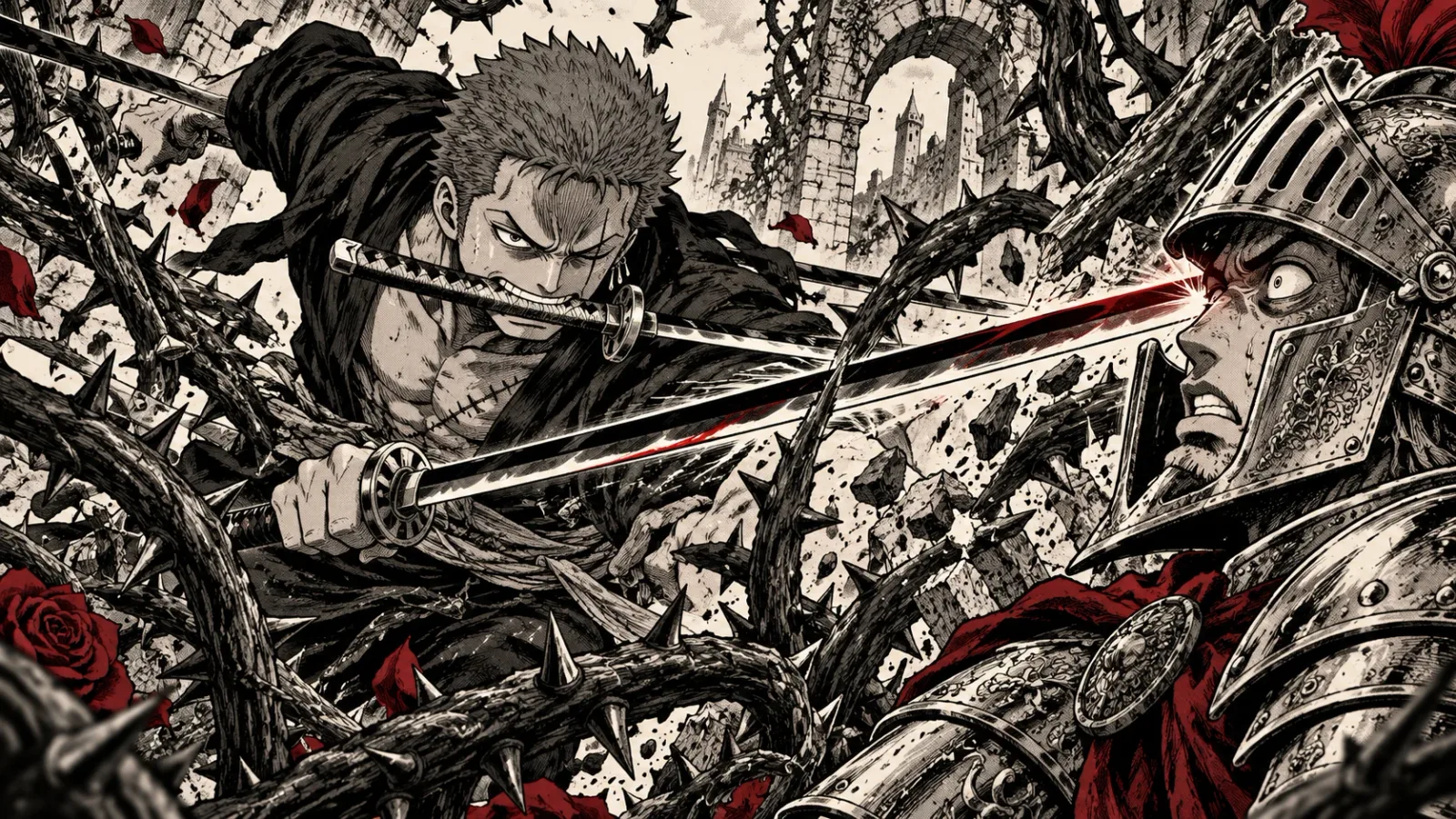
Zoro keeps attacking. He can cut Sommers, but ordinary damage is not enough to settle a fight against this regeneration. Severing a hand merely creates another demonstration of the enemy putting himself back together. Zoro needs the kind of attack that makes the damage last.
Sommers responds with Thorn Launcher, producing monstrous, cannon-mouthed thorn creatures. The spectacle expands the duel, but it does not solve his central difficulty: Zoro remains intent on working out his own power instead of being intimidated by the display.
The chapter also distinguishes the effects surrounding Zoro’s swords from the result he needs. A blade looking dangerous is not reliable proof that he is applying Supreme King Haki correctly. Sommers’ continued recovery makes that difference impossible to ignore.
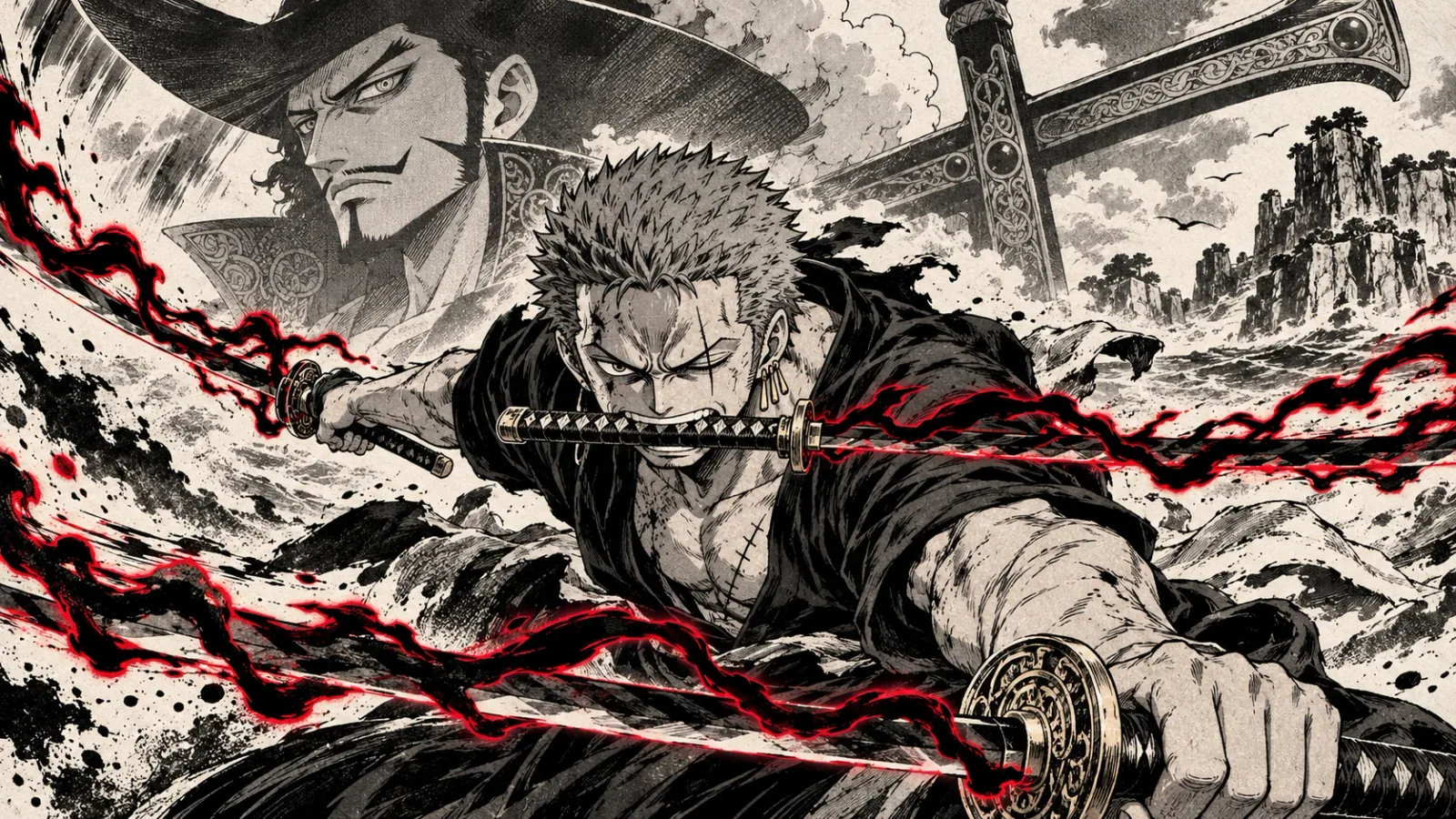
Zoro recalls Gaban’s expectations and Luffy’s observation that his Haki has been leaking out. Then the scene returns to his training with Mihawk, with Perona present. Mihawk speaks about a world in constant change and the strength of a conqueror’s sense of self. He also reiterates that this kind of Haki cannot simply be acquired through training.
That memory helps Zoro connect his existing power to deliberate action. Black lightning accompanies his attacks, and the later damage to Sommers does not immediately vanish as before. By the closing pages, Zoro has drawn his will into his blades and tied on his bandana. Sommers is staring at an opponent whose most important limitation has just begun to fall away. The duel itself is not finished in this chapter.
What it means
This is a control breakthrough. Zoro’s possession of Supreme King Haki was already part of the story: Kaido recognizes it in chapter 1010, and the fight with King in chapter 1033 develops its use alongside Enma. What changes on Elbaph is his understanding of how to call on that strength consciously.
That makes the training memory more useful than a new technique appearing from nowhere. Mihawk supplied an idea. Earlier battles supplied the experience. Sommers supplies a problem that forces Zoro to connect the two. Readers can still find the pace of that realization abrupt, but its ingredients have a history.
Mihawk’s words also clarify why Zoro’s loyalty to Luffy need not diminish his own ambition. Serving a captain does not mean losing the self that makes his will formidable. Zoro’s promise and chosen path remain his own, and becoming dependable at this level helps him keep them while supporting the crew.
Sommers provides a pointed contrast. He mocks the gap between talent and execution, yet depends on powers that repeatedly rescue him from the consequences of being struck. His confidence rises whenever Zoro fails to reproduce the right attack. Once Zoro begins succeeding, that safety looks much less reassuring.
Sommers calls Omen a counterpart to Supreme King Haki specifically, in the official chapter. That is more precise than treating it as the opposite of every kind of Haki. It tells us how he understands the threat, while leaving the limits of that relationship unexplained.
Theories after chapter 1194
Confirmed development: Zoro can deliberately bring out the power he was struggling to control. The closing attacks change the situation. That does not mean he has reached the limit of his Haki or already defeated Sommers.
Strengthened, not confirmed: Mihawk possesses Supreme King Haki. His detailed understanding makes the theory compelling. Explaining an ability is still different from explicitly demonstrating or confirming his own possession of it.
Unsettled: exactly how Omen interacts with Supreme King Haki. Sommers’ description establishes a relationship. Claims that Omen cancels every form of Haki, or that every Knight lacks personal Haki, go beyond what this duel proves.
Still speculation: this defines Sanji’s route to the same power. Mihawk’s emphasis on selfhood invites the connection, but chapter 1194 stays with Zoro. Our existing Sanji theory explores later developments and contains spoilers beyond this chapter.
Clarification, October 30, 2026: Sommers’s Omen comparison concerns Supreme King Haki specifically; the earlier wording generalized it to Haki as a whole.
Spoilers through chapter 1194.