Sommers has spent this fight explaining why Zoro cannot win. In chapter 1195, he stops explaining and runs. That reversal is funny, but the rest of “Weakness” is less comfortable: Brook cannot talk Gunko out of her chosen identity, and Sanji cannot kick his way past an old habit.
What happened
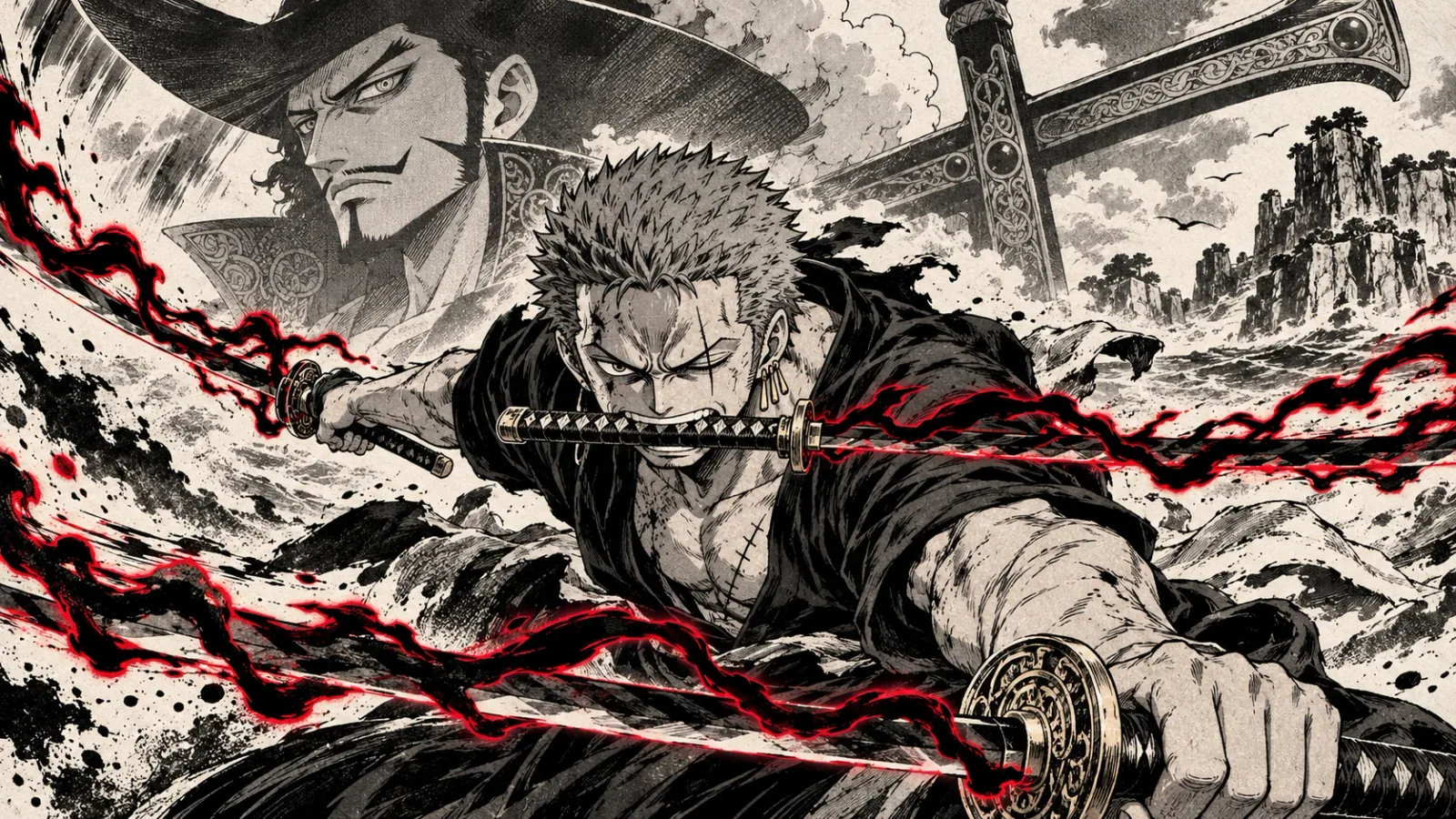
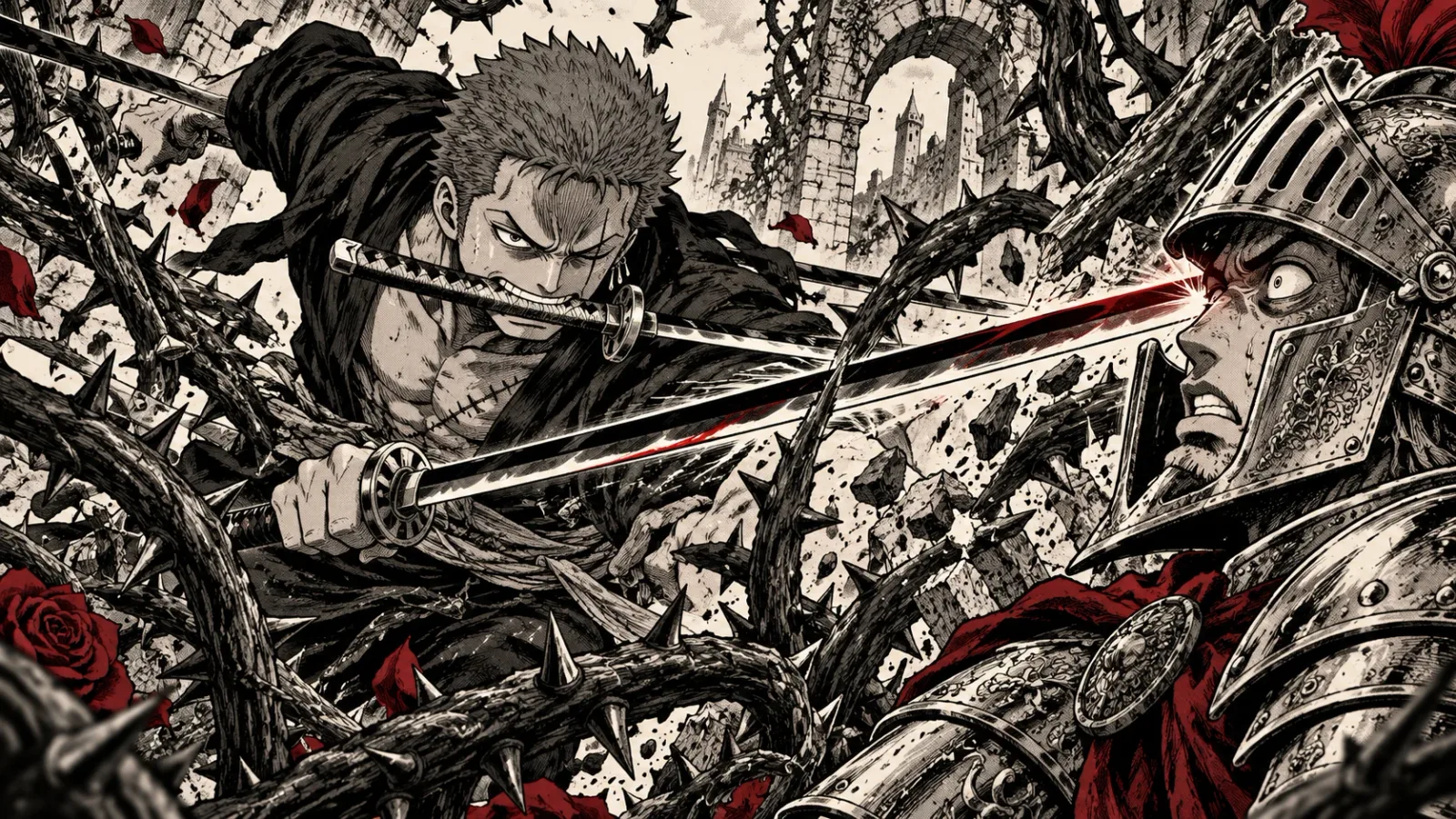
Zoro follows through on chapter 1194’s breakthrough. Sommers flees, frightened that his life is finally in danger. Zoro catches him and delivers another cut. The gap between the Knight’s earlier confidence and his panic supplies the payoff.
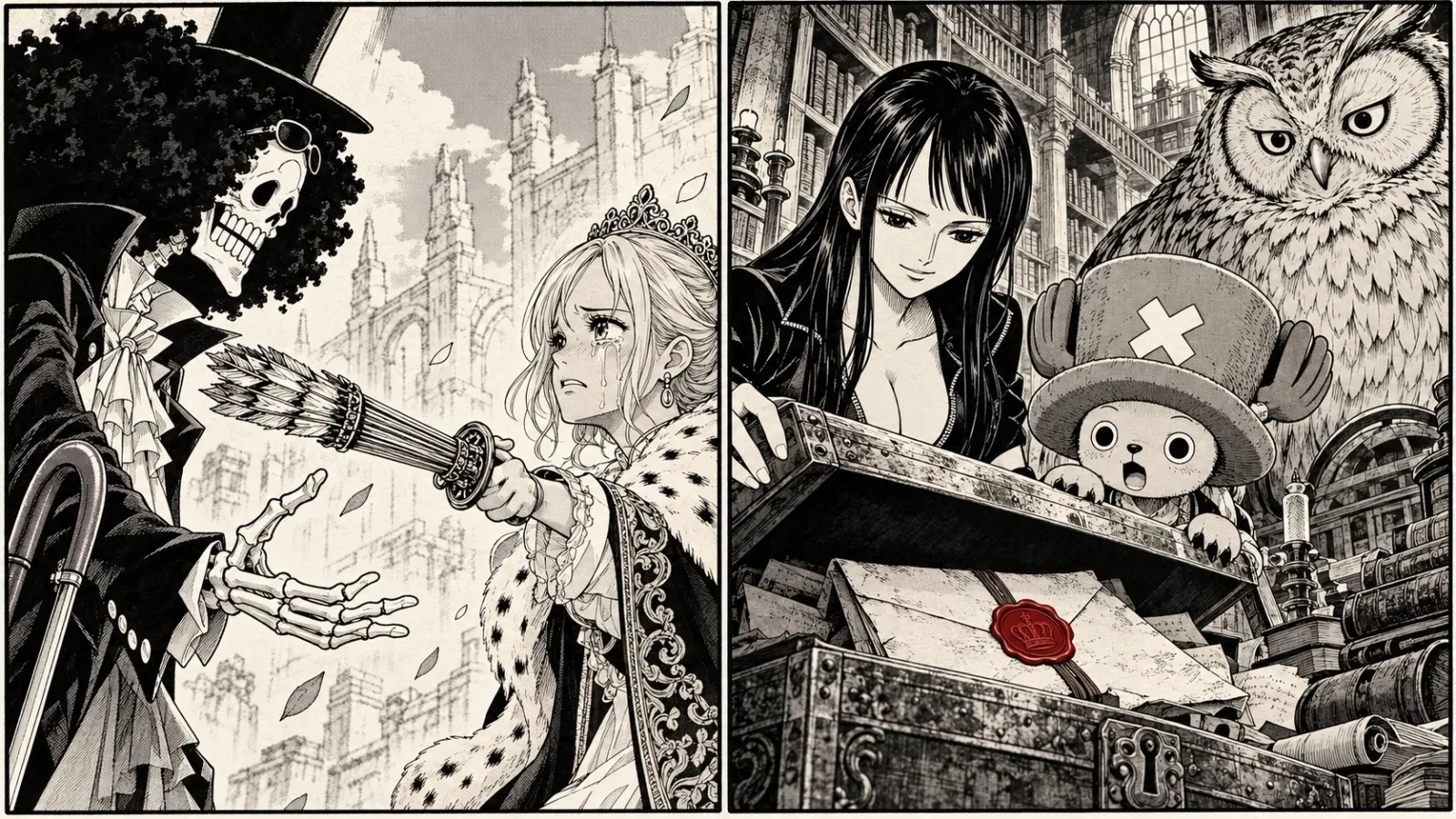
Gunko wakes before Brook’s group. Memories of her former life and her plea to Imu surface, but Brook’s recognition of Princess Shuri does not produce a reunion. She tearfully identifies herself with the Manmayer family, attacks using a stance Brook recognizes, and leaves.
At the Owl Library, Robin, Saul and Chopper examine Biblo’s inherited chest. Chopper translates the owl’s account of a human called Lili who once lived on Elbaph. Robin recognizes the name; readers still do not see the contents.
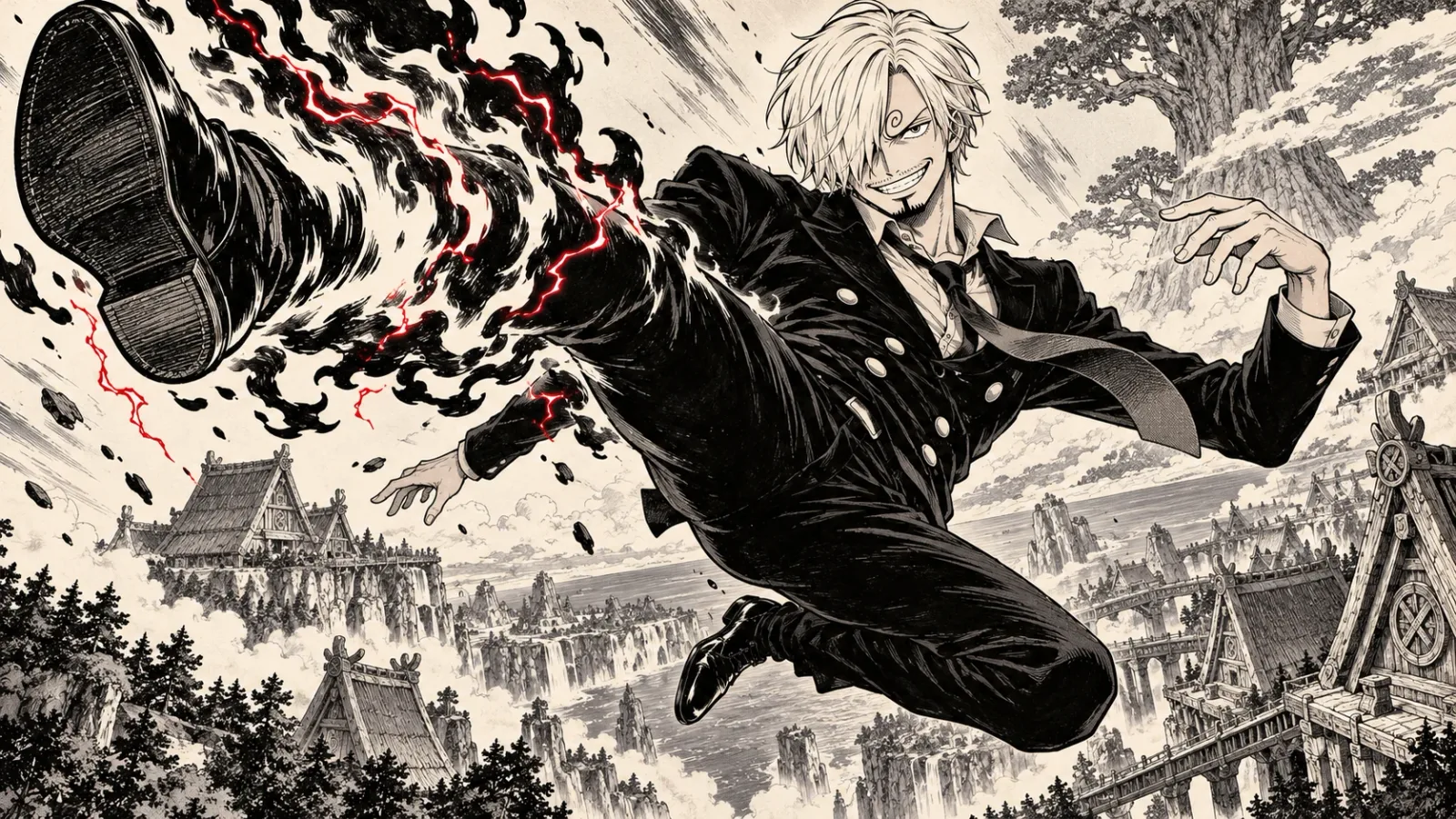
In the Western Village, four children remain in danger. Sanji’s Ifrit Jambe tears Killingham apart, only for the Knight to recover. Killingham wounds him with Longinus and attacks his confidence. Sanji remembers Gaban questioning his self-destructive tendencies, followed by a warning from Ivankov during his timeskip training.
These scenes are in the official chapter.
What it means
Zoro’s win in this exchange is useful because it changes an opponent’s behavior. Sommers no longer treats injury as a temporary inconvenience. His retreat shows that Zoro has made the threat credible. It is a stronger measure of progress than black lightning alone, though it does not give us a final account of the Knight’s fate.
Sanji has the opposite problem. He can inflict spectacular damage without securing the result he needs. The children are still at risk, and Killingham can keep returning. More force through the same method has become an expensive way to stand still.
The remembered criticism gives that stalemate a personal edge. Gaban sees potential in Sanji but questions the way he treats himself. Killingham uses the same vulnerability to humiliate him. Advice and cruelty can target the same sore point without deserving equal trust. Sanji needs to distinguish the person trying to help him from the enemy trying to make him surrender.
Brook makes a different attempt at help. He allows for the possibility that Shuri suffered rather than freely choosing everything she did. Gunko’s hesitation makes that offer matter, but it does not prove that she is ready to accept it. Recognizing a familiar sword stance gives Brook a connection to pursue; it gives him no control over her answer.
The library scene needs the same restraint. The name points strongly toward Alabasta’s missing queen, whose absence and letter are discussed in chapters 1084–1085. Biblo has not yet supplied the full name Nefertari D. Lili or explained who wrote the letter in the chest. That gap is where the theory begins.
Theories after chapter 1195
Sanji’s Conqueror’s Haki becomes a stronger possibility. The contrast with Zoro, Killingham’s taunts and Gaban’s assessment all direct attention toward it. None is an on-page awakening. The immediate question is whether Sanji can change how he fights, whatever power follows.
A Lili connection is strongly suggested; the contents remain unknown. A letter and a tool were mentioned in chapter 1193. A complete Void Century account, a weapon or a personal keepsake are predictions, not items the chapter identifies. Our Lili theory separates those possibilities.
Gunko’s memories complicate her allegiance. Her distress supports the hope that Brook can reach her. It does not establish that the Covenant has released her, or that she has joined the Straw Hats.
Correction, October 30, 2026: An earlier version identified Biblo’s Lili as Nefertari D. Lili and treated the chest as hers. The chapter names Lili without confirming that identity or ownership.
Spoilers through chapter 1195.