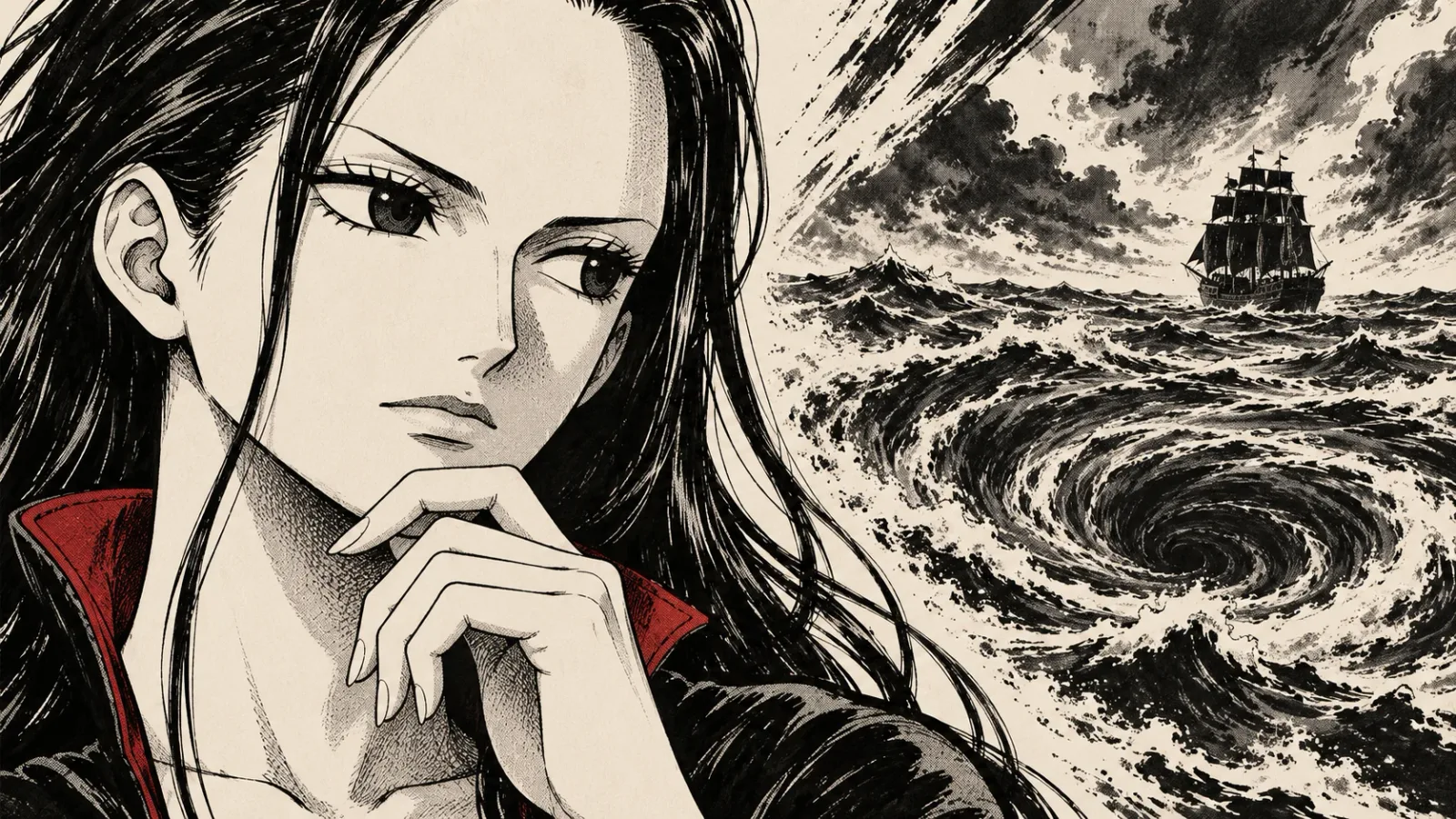
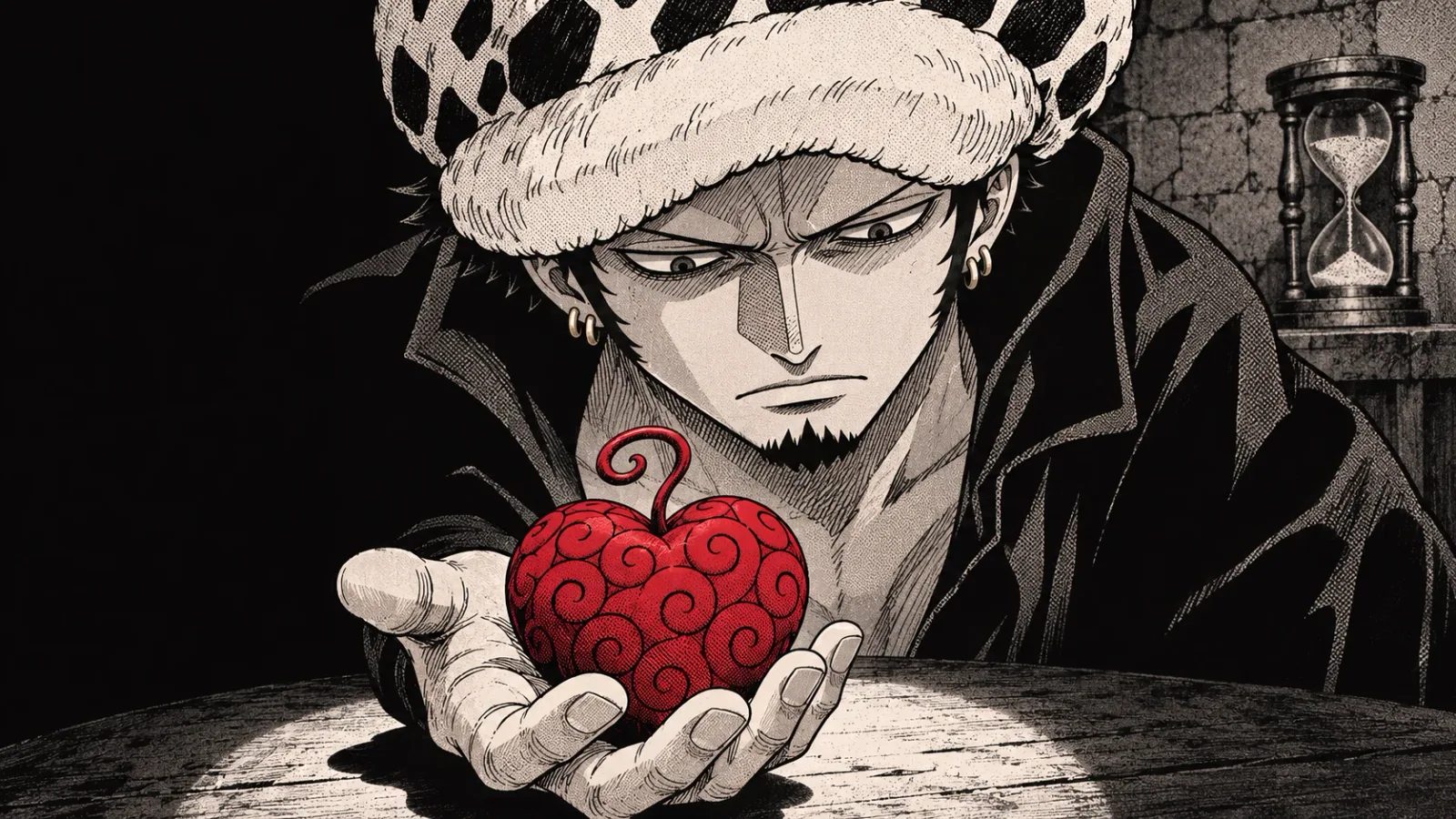
Imu has survived from the age that the World Government erased. Law carries a fruit with an operation that can grant eternal youth. Those two facts fit together beautifully—and leave one rather large question: who actually performed the surgery?
The theory is that a previous Ope Ope no Mi user sacrificed their life to stop Imu aging. It remains a strong explanation for his longevity. Explaining every power he gives the Holy Knights is a much bigger claim.
The case starts in Dressrosa
Chapter 761 establishes the operation and its price. Law knows that his fruit can grant someone perennial youth, at the cost of the user’s life. Doflamingo wants access to that power; this is an ability discussed by characters who understand the fruit, rather than a rumor assembled by readers. The official episode 700 recap also states both the gift and the fatal cost.
That makes the fruit a ready-made answer to an ancient ruler who still looks young. Oda would not need to introduce another longevity mechanism to explain Imu’s survival.
Chapter 761 also places the operation beside Doflamingo’s claims about Mary Geoise’s national treasure and seizing control of the world. That proximity makes a connection tempting. But the chapter’s dialogue, available here in an unofficial Spanish translation, does not identify Imu as the treasure or name a past patient. Doflamingo’s ambition is a clue, not a surgical record.
Ivankov makes the connection—and Elbaph strengthens it
In chapter 1086, Ivankov connects the Imu Sabo saw with Saint Imu of the Nerona family, one of the founding twenty monarchs from 800 years ago. He reasons that an ability to grant perennial youth must have an actual beneficiary somewhere. An ancient sovereign whom even the Five Elders obey is a compelling candidate.
At that point, Ivankov allows for the possibility of a shared name. Chapter 1179 goes further: Imu’s introduction identifies him as Nerona Imu, one of the First Twenty. The chapter’s closing introduction strengthens the historical identity behind Ivankov’s argument. The ruler in front of us belongs to that founding generation.
This is why the theory has substance. It joins a defined ability to a character with the precise problem that ability could solve. Its weakest link is no longer simply whether today’s Imu is connected to the ancient king. It is whether this particular operation explains his survival.
The Holy Knights do not settle the surgery question
Elbaph makes it easy to bundle youth, regeneration and obedience into one explanation. Sommers’ metal heart is especially suggestive when Law’s abilities already make hearts feel like familiar territory. Ohara’s recent analysis explores those hearts while acknowledging uncertainty about their construction and origin. The visual resemblance invites a theory; it does not identify the mechanism.
We should keep three questions separate:
| Question | What the evidence establishes |
|---|---|
| Could the Ope Ope fruit explain Imu’s youth? | Yes. Perennial youth is an established ability. |
| Does Imu control the survival of his servants? | Saturn’s death in chapter 1125 shows a lethal power over a subordinate. |
| Did surgery create the covenants or metal hearts? | The connection remains speculative. |
Saturn’s death is the useful countercheck. Imu condemns him for letting Joy Boy escape, and Saturn is reduced to bones. That scene demonstrates how dangerous dependence on Imu is. It does not show a former surgeon, explain Imu’s own longevity or establish that Law can reverse it.
The Wiki’s current account likewise distinguishes Imu’s immortality from the proposed Ope Ope explanation for it. An account of what Imu can do is not automatically an account of how he acquired it.
Verdict: a strong explanation, with a missing patient history
I lean toward a previous Ope Ope user having granted Imu perennial youth. The established operation, Ivankov’s reasoning and Imu’s founding-generation identity give it a clear chain of evidence.
The strongest objection is that longevity alone cannot tell us its source. Imu has extraordinary powers whose relationship to the operation remains unproven. A flashback naming the user or showing the procedure would resolve that gap; another regeneration scene would not.
For Law, the distinction matters. His fruit may explain something done to Imu centuries ago without requiring him to repeat the sacrifice today. Until the story establishes a reversal, predicting that Law must die to undo Imu’s youth adds a second theory to the first.
Spoilers through chapter 1197.